Tuesday, October 6, 2009

Waterberg Plateau Visit


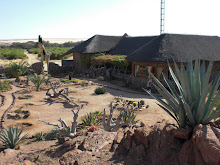
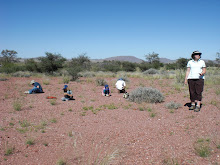
Just returned from visiting the Waterburg Plateau. The Plateau is located 150 km or so north of Windhoek. It is a most strange geologic formation that resembles many of the mesas of the Arizona/New Mexico region. It began to form over 300 million years ago and is an interesting mixture of sedimentary rock that has also seen volcanic activity. The sheer rocky face of the Plateau contains every shade of orange and brown and is dotted with psychedelic lichens of neon yellow, green or even blue. We hiked all the way to the top on one of the days of our visit. Annie did the best job, especially since we were moving almost vertically towards the top of this thing. I think her lower center of gravity helped her maintain her balance better than the older members of our family. The view was spectacular from the top.
We were pretty pooped when we descended the trail, but we still had a little left in us to visit the German cemetery on the grounds. Waterburg is the site where the Germans and the Herrero people clashed during the height of German colonization of the area. The Herrero, needless to say, lost. And the infamous ‘annihilation order’ was subsequently issued. It was rescinded sometime later by the Kaiser himself, but not before the death of many an indigenous man, woman or child. Most of the Germans buried there, however, did not die as a result of battle. They died mostly from disease or from the lack of appropriate medical attention after the battle.
In more modern times, the place has recently been turned into a resort complete with “chalets”, a restaurant and a humungous pool (which of course Annie fell into with all of her clothes on). There’s also camping for the more modest budget. Game drives are offered as well and guided hikes. Since we were staying up the road a bit which offered its own game drives, we just availed ourselves of the well marked hiking paths. Unfortunately, we weren’t able to spot the black rhino that inhabits the top of the plateau.
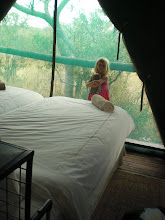
The lodge we stayed in was called WABI and it is a most interesting place indeed. Its décor is a bit of a throwback to the early eighties. It's also filled with hunting trophies from its earlier days when it was a hunting lodge. Its owner, Christine, is the ultimate hostess. She is the type of person that seems to anticipate one’s needs before one can even verbalize them. Our kids ate up her three course dinners with gusto, which is saying quite a lot. Because WABI is located so far in the bush, much of what is needed for the lodge is produced on site. There are ducks and chickens whose eggs are eaten at breakfast. So the experience was also much like being on the farm. The meat course is usually of some sort of game variety so we were offered kudu steaks, kudu stroganoff and springbok in a nutmeg sauce. Yum!
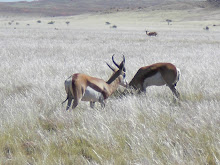
There were other animals just for the viewing—giraffes, sable, oryx, white rhinos, hippos, wildebeest, kudu, lechwe and black-faced impala—just to name a few. The lechwe are bred there for live sale to other lodges. It is normally an animal that inhabits Northern Namibia in the Okavango Region. Additionally, there was a flock of magnificent peafowl; the alpha peacock of the bunch being the most beautiful and well kept we’ve ever seen. They tended to roost on our doorstep, the roof, the exterior window sills or just about anywhere they darn well please. A small herd of nyala roamed free among the ‘chalets’ and the kids were able to get some really up-close and personal shots of them. Lastly, a pair of injured and / or elderly cheetahs were kept in a huge enclosure where they could be fed and kept safe from predators. On our last morning there, Christine took a group of tourists into the enclosure and one of the cheetahs began to express his discontent over the situation and it looked like it might be curtains for the tourists, but one of the bigger women in the group averted disaster by shooing him away like one would a troublesome dog. Emma said her knees were shaking after witnessing that little scene. What an interesting departing gift!

Wednesday, September 16, 2009

More on Driving in Namibia


Well, you all know how I feel about driving here since it was the topic of one of my first blog entries. It’s not just the fact that driving is done on the “wrong” side here that makes it difficult to adjust to; it’s all the various and sundry other crazy things that occur as well that contribute to my being a nervous wreck behind the wheel.
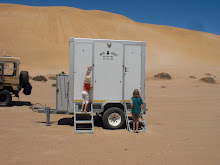
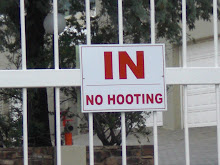
First anything goes here. Like the photo above demonstrates, four-wheelers are allowed to be driven on city streets. As you can see from the picture, they’re even licensed! We’ve seen dune buggies, three-wheelers, elderly chair scooters, etc. If it’s got wheels and a motor, we’ve probably seen it on the streets of Windhoek.
Additionally, there seems to be a high tolerance for risk taking behavior here. Safety appears to be a non-issue for Namibians. Parents think nothing of driving with kids in their lap, in the front seat unrestrained or packed to the gills in an open-bed bakkie (pick-up truck). I cringe every time I come up behind one of these vehicles because I can envision a kid falling out right in front of my on-coming vehicle and me running over him/her with my kids in the car.
Taxi drivers are the absolute worst, however. They will make two lanes where there was only one originally. They’ll turn right in front of you even if you’ve got the right of way. They typically jump the light before it turns green and run the red ones. They’ll pass you in town, in neighborhoods or any time they feel like it even if the road signs indicate against such. An acquaintance from school is currently driving around with a huge dent in her driver’s side door where she “was kissed” by a taxi! Because there are zillions of taxis, they can't be avoided either.
Perhaps it’s the German influence, but excessive speed is a major factor in road accidents here in Namibia, so many of which end in a fatality. Drivers treat these little two lane shoulder-less roads as if it were the Autobahn. Posted speed for the “highway” is 120 km. That’s 75 miles per hour on a road that’s not even close to being in interstate condition. Mind you, that’s the posted speed; people are typically flying by us and so we figure they’re up to 150 or 160 Km. Encountering a wart hog or an oryx at that speed would spell sheer disaster, but it’s as if most drivers don’t even give it a second thought.
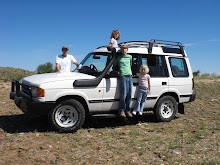
She may be slow and lumbering, but she’s built solid like a rock. With her bull bar in the front, Ole Bess can out intimidate most other vehicles, so we’re hoping that we can stay safe and sound for the remainder of our 3 month stay here in Namibia. We’ll be sad to part with her when the time comes. She’s been such a good girl.

Friday, September 11, 2009

Gus Wins Silver at the 27th Annual Namibian National Science Fair


Held September 8-10, 2009, Gus’s Birds in My Backyard project earned a score that qualified him for the silver medal in the category of Biology. Hundreds of kids from around the country descended on the exam basement of the Polytechnic, Namibia’s premier university for the three day event. WIS had only two entries to advance to this high level, Augustus’ and his classmate Sharifa’s. The competition was pretty stiff especially from St. Paul’s and St. George’s, well noted for their strong programs in both academics and athletics (somewhat like Catholic of Baton Rouge and Episcopal), but his research held its own in the end. Incidentally, Sharifa also received a silver (they are pictured together above). Both may qualify to attend the next level in South Africa—we’ll keep everyone posted. We, his parents, are extremely proud of him, needless to say!

Wednesday, September 9, 2009

The “Eisheiligen”—Being Cold in Africa


When Reid was finally awarded the Fulbright and we had to make decisions about what to bring with us to Namibia, we did a bit of research into the climate. We knew that Namibia, being a desert country, was prone to some pretty low temps especially at nighttime. The statistics indicated that during the Winter (June-August here) nighttime temps typically fell around the freezing mark (0 degrees Celsius). Daytime temps however were quite mild according to the literature—hovering in the upper teens and low twenties Celsius (50’s & 60’s F). We thus packed a few sweaters and light jackets. We did not even consider heavy duty pjs or coats. What with Reid being the packing Nazi that he was, we were lucky to make it here with enough underwear in tow. Upon arrival in December, mid-summer, we were glad we had brought our Louisiana cottons and clothing of other light weight fabrics. With the approach of winter, many of our Namibian acquaintances kept telling us to brace ourselves. We tended to down play it, after all being from the Northern Hemisphere and Reid a native Iowan to boot, it would take snow and ice to scare us, a most unusual sight in Namibia to say the least. Little did we understand, however, the ways of Namibian construction. Most of the houses here are built with the heat in mind. Walls are made of thick brick that are designed to keep the interior cool. The exterior is usually painted a light color so as to reflect the sunlight. Windows are just basically panes of glass and don’t do much to resist either the cold or heat. Insulation as we know it is virtually non-existent here. The term furnace as a household item does not exist in the Namibian vocabulary. So when the Namibians experience freezing temperatures; it is not only freezing outside, it’s literally freezing inside as well! Literally!

To try and keep warm during this time, we’d turn the oven on and open the door to let the heat warm the living space of our tiny flat. We baked a good bit (needless to say, I’ve put on a few pounds as a result) but we finally had to succumb and purchase blankets and an electric space heater even though we’ve been trying hard not to spend money on things that we’ll just be leaving behind in a few months time. Finally the first of September drew nigh and we thought we were home free, this date being the first day of Spring in the Southern Hemisphere.

As if by magic, plants and trees that looked utterly spent have begun to sprout leaves and the most exquisite and exotic blossoms. We’ve had to really rethink our understanding of the workings of the natural world during this time. For us in the Northern Hemisphere who understand that April showers bring May flowers, we are taken aback with the complete lack of rain prior to the onslaught of Spring. It hasn’t rained in months and won’t do so we’re told until November and yet trees have begun to green up and the flowers are popping out everywhere. Nights had begun to get warmer too. We had even broken a sweat at the first session of baseball practice we’d conducted at WIS. But lo and behold today we are experiencing what older Namibians refer to as the Eisheiligen. I’m not sure the origin of the word, whether German or Africaaner, but it roughly translates as the Ice Saints. Suddenly, the wind has begun to blow up from the South (yes, it’s the South wind that brings the cold here) and we’ve had to break out the sweaters again. I’m on my third warm beverage this morning and I can’t feel my toes in my shoes at the moment. We’ve got baseball practice again this afternoon and I hope the wind mellows before we get out on the field to toss the ball around. The Eisheiligen, we’re told won’t last long and the lovely spring weather should return shortly but a true Louisianian, I like my weather warm!

Please take note, with the Spring came the return to Daylight Saving Time here, so we are now 7 hours ahead of Central Time/ Louisiana & Iowa time. That is until you guys go back to standard time in October when the differential will again change!

Photo above: Annie celebrates her 6th birthday on a lovely Namibian Spring Day. We'd have been sweltering back in Louisiana.

Monday, September 7, 2009

Gus Goes to the Namibian National Science Fair


The National Science Fair of Namibia begins tomorrow, September 8, and Gus will be there. His bird project has taken him far and he’ll present his findings to the judges on Wednesday. Being held once again in the exam basement at the Polytechnique, Augustus is beginning to feel like an old pro at this business. What a wonderful experience for him as students from around the country will be there mingling and sharing their findings as well as their culture. We wish him the best of luck!
The pictures above are of the Long-Tailed Paradise-Whydah and the Southern Red Bishop.

Sunday, August 30, 2009

Thursday, August 27, 2009

Ndhovu Lodge, Rundu, Otjiwarongo & Ole Bess

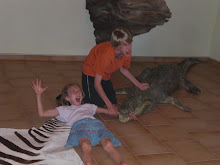
While at Ndhovu we went on two game drives, one with Horst in the Bwabwata National Park, the other on our own in the Mahango Game Park. We saw a wide variety of wildlife in both: hippos, crocodiles, kudu, roan and sable antelope, water monitor, vervet monkeys, elephants, water buffalo galore and even a python. Although not in evidence in the same numbers as in Etosha, we did feel like we had seen more types of birds and animals than in our previous experience. In Mahango, we even had an elephant just about charge into us as he was wanting to cross over to the other side of the road just at the spot we had stopped the vehicle. We managed to get Ole Bess cranked up and out of his way just in the nick of time. The kids found that to be very exciting and Augustus was able to get a number up close and personal shots of him as he nearly grazed the Rover. He didn’t appear too angry though, so Reid was thinking that maybe we could have waited him out another click or two….I for one am glad that we made our escape when we did. Saw huge Baobab trees along the drive and were treated to dancing and singing by the lodge staff at Ndhovu after dinner that evening. Speaking of Ole Bess, well what kind of adventure would it be without some sort of input on her part? After our game drive in Mahango, Reid noticed that the steering was getting a bit tight. He got under her and discovered that the power steering line was leaking rather badly. Reid made mention of our circumstances to one of the staff, who in turn radioed Horst, in town to pick up provisions, who picked up some power steering fluid for the old girl. What was to be done about the leak, however? Horst indicated that we could get the line repaired in Divundu. Divundu, readers, is about the size of Morganza and then again I might be exaggerating. Next door to the Engen combined petrol station and supermarket is the 435 Garage. This place looks more like a car graveyard than a repair shop. It consists basically of a shack with a few tables containing tools with derelict cars and car parts strewn willy-nilly about the yard. Reid stood around for about 5 minutes before anyone appeared. When the guys did so, they were fairly efficient but had to send the line off to someone else to have it brazed---ah, the weak link in the repair process. Needless to say, the repair did not remain repaired for very long and we found ourselves in the same circumstances of having a leaking power steering line when we arrived in Rundu some hours later after picnicking briefly at Poppa Falls. Rundu, a hodge podge sort of town with its people spilling out into its streets everywhere hasn’t got a whole lot to offer to its tourists, but we did find a competent mechanic there who got Ole Bess back in her running shoes. Rundu sits on the South side of the Kavango River across from Angola. We took a boat ride with the lodge where we were staying and got a good deal of insight into the everyday life of the people on the Angola side. There were loads of fishing boats made from what looked to be dug out tree trunks, some being used to ferry passengers to Namibia, others for their intended purpose. Since it was nearly sundown, many of the villagers were bathing, brushing teeth and washing clothes in the shallows and on the river bank--the children splashing happily, oblivious to their poverty. The Kavango is also the source of their drinking water so it’s a good thing that it flows rather rapidly at this point given the heavy usage it gets by the local inhabitants. Rundu offered a glimpse to our kids of the Africa with which Reid and I had been acquainted through our Peace Corps experience. It’s a place that has largely escaped the influences that Windhoek and environs were subjected to and as a result retains its “disorganized” qualities that lend a certain charm to the town. Stopped in Tsumeb on the next leg of our journey. Tsumeb is a pretty little old mining town that is well kept and one can still find lots of interesting stones and minerals in the vicinity. Of course, Augustus obtained several new acquisitions to his rock collection. Visited the museum there and had lunch at a “biergarten.” Stayed the night in Otjiwarongo and toured the Crocodile Farm in the morning. Would have had lunch there, where what else but crocodile is featured heavily on the menu, but Annie got sick so we headed back to Windhoek. Were glad to get back to our temporary home sweet home and a functioning washing machine after so many days on the road!