Wednesday, August 26, 2009

Sleeping with the Hippos


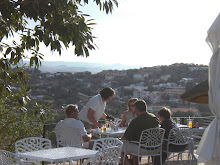
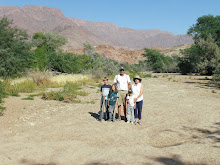
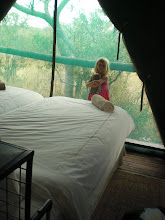
After our interlude at Roy's, we headed up to the Caprivi Strip, a little narrow thumb-like projection on the Northeastern corner of Namibia that touches Angola, Zambia and Botswana. The area is noted for its diversity of wildlife, open-flowing rivers and angling appeal. Our fellow Fulbrighter family, the Powells, had recently been through the area on their way to Victoria Falls and had stayed at a very cool lodge called Ndhovu where the guests are housed in Lobatse military style tents with a detached bath. The tents aren’t in the least bit Spartan, however. They are well appointed with embroidered linens, thick wool floor rugs and sparkling white mosquito netting. We seized the opportunity and capitalized on the Powell’s tip and scheduled 4 days and 3 nights there. We weren’t disappointed.
The main attraction of the lodge is that it sits right on the banks of the Okavango River. There just so happens to be a grassy island right in front of the lodge where a herd of hippos hang out for out 7 months of the year. Our tent was located just opposite the island and we were able to almost literally sleep with the 15 or so hippos that make it their home. Most were mothers with nursing calves. What a treat! The great part is that they’re nocturnal and so as we drifted off to sleep each night, we could hear them milling about in the river and on the bank right in front of our tent. They’ve got the strangest call that resembles the laugh of Jabba the Hut on StarWars.
Additionally, the owner of the lodge, Horst Koch, is very hands-on. He sits and has meals with the guests, takes them out on game drives and will even fetch supplies for one’s broken-down vehicle when necessary. (More about the Adventures of Ole Bess later). Horst is a wealth of knowledge and information and just a downright nice fella. He still owns a farm near Windhoek, but his heart is with the lodge in Divundu and that’s where he spends most of his time. His children live in different places around the world, so he’s got some work to do to get them to come back and take over the farm and free himself up entirely for life in the “unorganized sector” of Namibia.
Indeed, this area of Namibia is vastly different from the Central and Southern districts. The population is much denser up here. Many still live in traditional homesteads that can easily be seen from the road. Non-existent are the huge 20,000 hectare farms like in the South and life appears to be much more hard scrabble for people who engage in subsistence farming. The people must battle malaria here as well. No easy task when there is little money for prophylactic medication. Things aren’t as clean here as in the Windhoek area either and there is often trash on the roadsides especially near the larger towns. It is nonetheless a most interesting place to visit and we enjoyed it thoroughly.

Bushmen Village


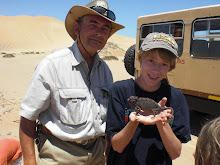
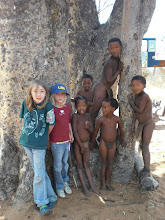
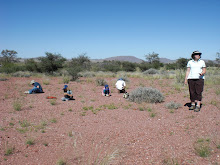
The following day we drove about 65 km to an historic living village of the /Xoa-o Ju/Hoansi gaon, a branch of the San people whom we typically refer to as the Bushmen. Most live in very dire circumstances since many of their traditional activities have been severely restricted. Although they have given up their traditional housing, they've replaced it with tin shacks and basic construction that isn't much of a step up. To try and support the village, they have turned to putting on demonstrations for tourist groups. They will even walk one out into the bush and show how they track and hunt animals. We didn't think our little ones would be able to keep up with such a demanding pace, so we elected their crafts program wherein some of the tribespeople showed how they make jewelry, bows, arrows and fire. Most of them spoke their native tongue; complete with all of the clicking sounds just like in the movie, The Gods Must Be Crazy and very little English. So, one of the younger members of the tribe did the translating. He's pictured with Augustus above. Not much bigger than Augustus, he indicated that he was 19 years old. They were all attired in their traditional clothing which is to say very little clothing at all--loincloths, and the women wore something similar looking in the front but with a much longer back piece to cover the nether parts. Many of the women had their babies tied to their backs while they used natural materials to create all sorts of marvelous jewelry confections of seeds, ostrich egg shells, and wooden beads. They did so with the most primitive of hand tools. One man made a bow, set of arrows and quiver in the time we observed him. He used giraffe bone to make the arrows as well as some more modern iron tips. Making fire seemed to be a fine art. The translator, Elias, didn't appear to be as skilled as the older man and seemed to endure some good-natured ribbing from the ladies as a result. Augustus gave it a try and remarked on how difficult it was to keep up the speed on the rubbing stick.

When the older Bushman finished creating his hunting weapons, he showed us how game is tracked in the bush. He had a target set up and shot three arrows. He narrowly missed it each time. When we gave it a try, we realized how difficult it was to secure one's dinner. All of us with the exception of Annie gave it a try and we'd have all gone hungry that day had we to rely on our own prowess because most of us didn't even come close.

The tribe had a "craft shop" set up under the trees, somewhat of a roofless, wall-less, stick kraal with the crafts the tribespeople make hanging from sticks embedded in the earth. Emma bought a quiver and bow that included giraffe bone tipped arrows and the fire starter equipment. Augustus bought a bush knife. Annie's quiver was miniature size that she intends to hunt rats with. I got a multi-strand necklace made out of some sort of indigenous seeds. Our interpreter wrote everything down in his class notebook and calculted the total purchase prices on a scrap of paper while the little ones looked on from a neighboring tree.

It was a wonderful experience to see firsthand how the Bushmen have lived and existed for millennia. It was also somewhat sad to view a culture in the midst of disappearing. Because the San/ Bushmen are a nomadic people, their very way of life has been inalterably changed by virtue of the government confining them to a limited territory where they can no longer hunt the type of animals they were long accustomed to. It would be interesting to return in 20 or 30 years to see what has become of them and how they manage to adapt in this ever changing world of the 21st century.

Roy's Camp


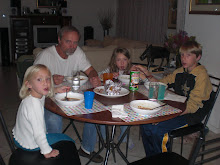
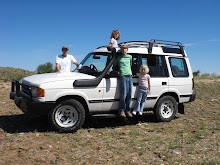
Began our big tour of the North of Namibia yesterday, 15 August. Ended the day at Roy's Camp, a funky little lodge/campground between Grootfontein and Rundu. The place is decorated with an eclectic collection of junk including such things as a huge wind chime/mobile made of among other things, a whitened giraffe skull. The remains of a 1930's Ford greet the guests upon arrival at the reception. The pool water is circulated through an old claw foot bathtub. We were housed in a two stroy A-frame thatched cottage called Lappa in Namibia. The staircase, made of rough hewn trunks of old trees sits at the exterior leading up to a small exterior veranda where the kids gladly made themselves at home. Since our bedroom was on the first floor and theirs was only accessible via the exterior stairs, they felt like they had their own private tree house club. We partook of the lodge's dinner and were quite surprised by its tastiness. The cook had prepared a very interesting combination of items--kudu steak, chichen wings, macaroni and a variety of salads. The kids actually ate everything on their plates and remarked that it was good. That in and of itself is a remarkable thing.

Friday, August 14, 2009

IWAN visits the Child Development Foundation


My friend Kelly Powell (the other Fulbrighter's wife) and I joined a women's group several months ago. The group, IWAN (International Women's Association of Namibia), consists of women from around the world. Their objective is to do good works as well as socialize (of course).

We meet every Tuesday morning for what's termed our "coffee morning". Most of the time, we meet at a member's house to discuss all of the group's on-going projects and have a chance to interact in a comfortable setting. Sometimes, however, we make visits out in the community. This past Tuesday, we went out to the Child Development Foundation near Goreangab Dam on the outskirts of Windhoek. The Foundation is affiliated with one of the town's Christian schools, All Nations School. They are a mission school that provides care and schooling for orphans and vulnerable children. It is a non-governmental, non-political, and non-profit organization. It was established in 2003 to help improve the quality of life of orphans and vulnerable children by feeding, educating and caring for those in need. They service over 65 children. They are regularly audited and have impressed the ladies of our executive committee with their good management skills.
Part of our visit included awarding the center's director, Ms. Ansie Maré, with a grant for the purchase of playground equipment. (See above photo.) IWAN has already ordered the items which will arrive at the end of the month, but we wanted to surprise the director and boy did we! She was nearly in tears, overwhelmed by the magnanimity of the gift. Additionally, we brought over a box of toiletries for use among the kids: toothpaste, toothbrushes, and soap. She nearly cried over this as well.
Ansie told us about a program that she is launching entitled, "Adopt an Orphan". You don't get to keep the child, but you do get to assume his monthly financial obligation to help relieve the financial stress on the center. Remember the center feeds each child two meals a day, helps to provide clothing, educates the children and provides transport to and from the child's home. Ansie will update you on the child's development throughout the year should you choose to participate. She can be reached at the following e-mail address: child@iway.na. I can also provide you with the center's banking details if you would just like to donate to its cause; just e-mail me.
Unfortunately, the center doesn't as of yet have a web presence. Kelly and I are going to try to help Ansie at least create a blog so that she can chronicle the center's progress at no cost. That's really funny that here in Namibia, I am considered a tech guru. My friends from Catholic who are reading this are probably laughing out loud.....
The photos are, of course, of our excutive committee members handing over the grant for the playgorund equipment to Ansie in the middle. The other is of IWAN's membership listening to Ansie's presentation in the school cafeteria. The third is of one of the teachers providing one on one instruction to a learner.

Monday, July 27, 2009

Gus Gets the Gold


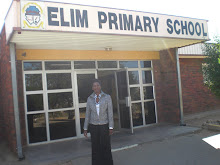
The Khomas Regional Science Fair was held July 15-17 at the Polythechnique of Namibia (the principal university in Namibia). Augustus having won the Teachers’ Choice Award at his school science fair in April qualified to attend. Over 250 participants showed up with their projects. For their efforts they received a t-shirt, box of CD-ROMs, and CD holder from the sponsors Kolok (Memorex distributor). Augustus was reluctant to go at first because he thought he’d be all alone in the cavernous examination basement of the Polytechnique, but he did encounter several people he knew when he went in to set up on the first day. He felt a great deal more comfortable returning the following day knowing that he’d have friends with whom he could at least chat.
On the evening of the third day of the event, the awards ceremony took place. The basement had been transformed into an auditorium and there were several hundred moms, dads and siblings in attendance. Fair officials indicated that they’d be as efficient as possible handing out the awards and they were true to their word. Our heads were spinning because children were called one after another with no indication as to what level or category. First the bronze medals were awarded—no Augustus Bates among them. Then, the silver medals were awarded and still no Augustus Bates among them. Finally, the gold medal was being distributed and the official called out OGOOSTUS BA-TEZ. Seeing that my child did not recognize his own name being called, no doubt because of the peculiar pronunciation of the Namibians, I shook his leg and got him to realize that he had gotten a gold medal. We laughed heartily that he didn’t even know he had won a medal until he got back to his seat.
All in all, I think he is pleased in retrospect that he spent a part of his break time doing “school work” while most of his classmates were vacationing. He has certainly racked up on the freebies that have been handed out at each level—t-shirts and the like. We’re not yet sure whether or not he’s qualified to attend the National Science Fair, but we’ll know shortly.
Tuesday, July 14, 2009

Nando's Peri-Peri Chicken Jambalaya

There are very few options regarding fast food here in Namibia. Neither McDonald’s, Wendy’s nor Burger King have yet made it here. This may or may not be a good thing. The only American chain in evidence is KFC. Additionally, the local equivalent of the burger joint, Steers or the Hungry Lion, just don't cut the mustard. The kids are really missing Raising Cane’s chicken tenders, which probably goes without saying. One chain that we have come across and like very much is Nandos. Nandos produces a Peri-Peri grilled chicken for which it is famous throughout Southern Africa. Peri-Peri has a unique flavor that takes a little bit of getting used to, but man do we like the spicy hotness of it. We have been buying 2 family packs which total a whole chicken and comes with fries and coleslaw for well under twenty American dollars. We’ll usually have a bit leftover depending on our appetite for the evening. Lately, I have been taking the leftovers and remodeling them in the form of chicken jambalaya. The kids absolutely love it. Add a little Tony’s and it’s almost like home! Talk about Cajun ingenuity.
By the way, we’re running a little low on Tony’s (even though I brought over 2 industrial size cans of it when we came over), so if anyone is interested in making a kind gesture toward our cause, our mailing address appears at the bottom of the page. The stuff they call Cajun Spice here just isn’t the same.........

Monday, July 13, 2009

Augustus the Budding Thespian?


Is there a doctor in the house? Dr. Brown, Dr. Brown please report to the stage.
To help illustrate the dangers of smoking, the year 8s at WIS (Augustus’ class) decided to put on a skit that they had written. This coincided with World No Tobacco Day at the end of May. One of the main characters was Dr. Brown. Augustus got selected to perform this role. He acquitted himself quite well having never before acted---at least not in front of an audience. Students from other levels also created anti-smoking posters and literature. Hopefully their efforts will not fall on deaf ears. Unlike in the U.S. where smoking is banned in most public venues, people smoke quite freely in Namibia. Often there aren’t even any designated smoking areas to separate the smokers from the non-smokers. It is particularly difficult to stomach in restaurants. Who would have ever thought that Louisiana is ahead of the game in this regard where smoking isn’t allowed at all in restaurants, other public venues and even in many bars?