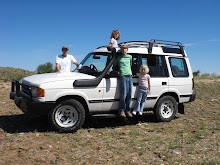
May 1st is a holiday here in Namibia as in most of the rest of the world. It is workers’ day—the equivalent of our Labor Day. We celebrate it at the end of the summer no doubt to get in a few extra days at the beach, but the rest of the world uses the May 1st date. Monday, May 4th is also a holiday—Cassinga Day. We’re not exactly sure what the Namibians celebrate on this day, but it means a four day weekend which for us means time to take off and explore some new area of Namibia. So, once again, we packed up the Rover and the kids and headed to Etosha. Etosha is the big National Game Park here in Namibia. It is just over 100 years old and boasts a large number of species in vast quantities. It is about a 5 hour drive from Windhoek and the road is tarred all the way there.
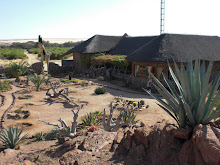
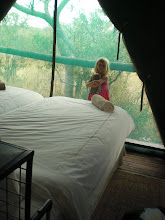
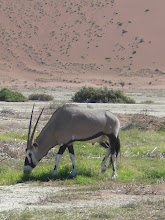
Staying inside the park presents an expensive proposition, so we decided to stay at a place just outside the southern gate (Anderson Gate) and drive in each day. We were very pleased with the accommodations because to quote Emma it allowed us to, “Live the dream—have all this nature at the same time having luxury.” The “rooms” consisted of elevated tents large enough to fit actual beds, which were quite comfy, shelving, pull-out couch and a vanity in each. The tents could be unzipped to the view of the outside while still being protected from the creepy crawlies by the netting. This was great because we were awakened each morning by the light of the rising Eastern sun. Outside, there was a toilet and outdoor shower that were decorated and concealed with wooden stick type fencing so as to maintain privacy. The kitchen was also outdoors with a working refrigerator, hot plate, sink, braaii pit and all of the necessary kitchen equipment. This was especially nice for us given that eating out for every meal for a family of five is much too costly and it allowed us to keep food expenses to a reasonable amount. The lodge’s restaurant did offer a nightly buffet of which we partook on our last evening there. The sides are of course pre-prepared but the meats are by choice and cooked right on the spot in front of the guest. The offerings included oryx, zebra, springbok, chicken and pork. Most of us opted for the springbok. We just can’t get enough of the stuff. The chef took great pleasure in grilling it up for us and even though his English was quite broken, he was most congenial. There was also the possibility of choosing a stir fry where another chef cooked up any concoction of given ingredients to one’s delight. The desserts were scrumptious as well. Needless to say the kids enjoyed themselves thoroughly.
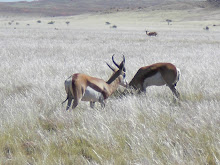
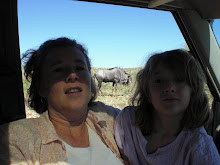
Etosha itself was absolutely fabulous. From Anderson’s Gate there is a 17 kilometer drive to the lodge at Okakuejo, one of the places available to stay inside the park. Lots of animals can be spotted along this route and we saw zebras, giraffes, birds and jackals. Within the park itself, we encountered so many zebras in our two days there that the kids started saying they were “fed up” with zebras. The springbok were even more numerous and were so close to the vehicle that one could have probably reached out and touched them. We purchased a map as one of the first orders of business which showed the waterholes. Some of the waterholes are maintained by park personnel and are equipped with solar-powered pumps so that the animals will have water all year ‘round. Others are not and we were surprised to see how many had already dried up given that the rainy season just ended in March. It took us a while to figure out which were dry and which still had water and which were the most frequented by the widest variety of animals but we did eventually and were rewarded with some of the most spectacular views of wild animals we’ve seen so far in Namibia. At one water hole there were black-face impalas, springbok, zebras, wildebeest, and elephants. We also happened upon four lionesses setting up for a kill by sheer dumb luck. They had a few zebras, including a baby, separated from the rest of the herd and were attempting to route them through a bottle neck so as to grab the baby no doubt. They had probably been setting this up all morning and we came upon the scene in the last few dramatic minutes when the action was coming to a crescendo. Emma was rooting for the baby zebra but we wanted to see the lionesses’ labor come to fruition. The adult zebras weren’t going to have any of it though, they kept really close to that baby and having more stamina than the lions pushed their way through narrowly escaping the lionesses’ handiwork. When it was all over, we felt like we had just taken part in an Animal Planet video. The lionesses just kind of sat there with their tongues hanging out looking like they were contemplating what went wrong. They appeared to take it in stride, nonetheless, as they leisurely regrouped and headed out in the opposite direction of their prey.
On the second morning, as we were driving on one of the less frequented roads of the park, we were graced with the appearance of a group of giraffes. They just gingerly stepped out of the side brush and onto the road right in front of the vehicle. They had a juvenile with them so we assumed that it was a family grouping. One crossed the road in front of us, loping to the other side and turned back to look at us like she was inquiring as to whether or not we’d gotten her photo yet. We were all awestruck for several minutes.
The only thing we weren’t able to see that we regret is the rhinos. Etosha is host to a large number of rhinos, the Black Rhino as well as the White. We understand that they have a tendency to frequent the waterholes at night. This is where staying within the park pays off given that each of the interior lodges boasts waterholes where visitors can view the wildlife even after the gates have closed for the evening to outside guests.
All in all it was a most remarkable visit and we feel so fortunate to have this opportunity to view such magnificent beasts in their natural environment. We wonder how many of these creatures will still exist in our children’s twilight years and are glad they got to experience it firsthand.
Staying inside the park presents an expensive proposition, so we decided to stay at a place just outside the southern gate (Anderson Gate) and drive in each day. We were very pleased with the accommodations because to quote Emma it allowed us to, “Live the dream—have all this nature at the same time having luxury.” The “rooms” consisted of elevated tents large enough to fit actual beds, which were quite comfy, shelving, pull-out couch and a vanity in each. The tents could be unzipped to the view of the outside while still being protected from the creepy crawlies by the netting. This was great because we were awakened each morning by the light of the rising Eastern sun. Outside, there was a toilet and outdoor shower that were decorated and concealed with wooden stick type fencing so as to maintain privacy. The kitchen was also outdoors with a working refrigerator, hot plate, sink, braaii pit and all of the necessary kitchen equipment. This was especially nice for us given that eating out for every meal for a family of five is much too costly and it allowed us to keep food expenses to a reasonable amount. The lodge’s restaurant did offer a nightly buffet of which we partook on our last evening there. The sides are of course pre-prepared but the meats are by choice and cooked right on the spot in front of the guest. The offerings included oryx, zebra, springbok, chicken and pork. Most of us opted for the springbok. We just can’t get enough of the stuff. The chef took great pleasure in grilling it up for us and even though his English was quite broken, he was most congenial. There was also the possibility of choosing a stir fry where another chef cooked up any concoction of given ingredients to one’s delight. The desserts were scrumptious as well. Needless to say the kids enjoyed themselves thoroughly.
Etosha itself was absolutely fabulous. From Anderson’s Gate there is a 17 kilometer drive to the lodge at Okakuejo, one of the places available to stay inside the park. Lots of animals can be spotted along this route and we saw zebras, giraffes, birds and jackals. Within the park itself, we encountered so many zebras in our two days there that the kids started saying they were “fed up” with zebras. The springbok were even more numerous and were so close to the vehicle that one could have probably reached out and touched them. We purchased a map as one of the first orders of business which showed the waterholes. Some of the waterholes are maintained by park personnel and are equipped with solar-powered pumps so that the animals will have water all year ‘round. Others are not and we were surprised to see how many had already dried up given that the rainy season just ended in March. It took us a while to figure out which were dry and which still had water and which were the most frequented by the widest variety of animals but we did eventually and were rewarded with some of the most spectacular views of wild animals we’ve seen so far in Namibia. At one water hole there were black-face impalas, springbok, zebras, wildebeest, and elephants. We also happened upon four lionesses setting up for a kill by sheer dumb luck. They had a few zebras, including a baby, separated from the rest of the herd and were attempting to route them through a bottle neck so as to grab the baby no doubt. They had probably been setting this up all morning and we came upon the scene in the last few dramatic minutes when the action was coming to a crescendo. Emma was rooting for the baby zebra but we wanted to see the lionesses’ labor come to fruition. The adult zebras weren’t going to have any of it though, they kept really close to that baby and having more stamina than the lions pushed their way through narrowly escaping the lionesses’ handiwork. When it was all over, we felt like we had just taken part in an Animal Planet video. The lionesses just kind of sat there with their tongues hanging out looking like they were contemplating what went wrong. They appeared to take it in stride, nonetheless, as they leisurely regrouped and headed out in the opposite direction of their prey.
On the second morning, as we were driving on one of the less frequented roads of the park, we were graced with the appearance of a group of giraffes. They just gingerly stepped out of the side brush and onto the road right in front of the vehicle. They had a juvenile with them so we assumed that it was a family grouping. One crossed the road in front of us, loping to the other side and turned back to look at us like she was inquiring as to whether or not we’d gotten her photo yet. We were all awestruck for several minutes.
The only thing we weren’t able to see that we regret is the rhinos. Etosha is host to a large number of rhinos, the Black Rhino as well as the White. We understand that they have a tendency to frequent the waterholes at night. This is where staying within the park pays off given that each of the interior lodges boasts waterholes where visitors can view the wildlife even after the gates have closed for the evening to outside guests.
All in all it was a most remarkable visit and we feel so fortunate to have this opportunity to view such magnificent beasts in their natural environment. We wonder how many of these creatures will still exist in our children’s twilight years and are glad they got to experience it firsthand.